
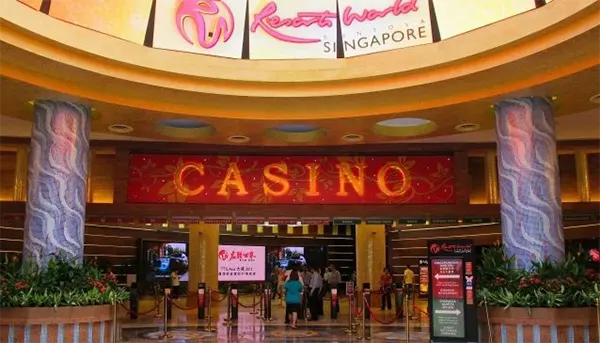
Resorts World Sentosa Casino (Singapore) — a practical review of the Sentosa Island venue
Resorts World Sentosa (RWS) Casino is one of only two licensed casinos in Singapore, located at 8 Sentosa Gateway inside the RWS resort area on Sentosa Island. It is built for visitors who want a large, closely regulated gaming venue rather than a casual drop-in: entry checks are strict, the dress rules are actively enforced, and local residents face a statutory entry levy. This review focuses on what matters in real life in 2026—how entry works, what you can actually play, and the guardrails Singapore uses to keep gambling harm under control.
Entry rules, identification checks, and the local entry levy
The first non-negotiable detail is age: entry is restricted to people aged 21 and above. Staff may request valid identification at the entrance, and you should expect checks even if you have been before. For tourists, the practical approach is simple—carry your passport (or an accepted travel/identity document) and allow extra time during peak periods, because queues can form when there are events elsewhere on Sentosa.
Singapore Citizens and Permanent Residents are treated differently from foreign visitors. Residents must pay an entry levy before entering, and the levy is not a “ticket” you can refund later if you change your mind. In 2026, the published levy levels are S$150 for a daily levy and S$3,000 for an annual levy, and they are designed as a friction point to reduce impulsive repeat visits.
It is also worth knowing that levy purchase does not override restrictions like exclusions or visit limits. If someone is under an exclusion order or a visit limit, they can still be refused entry even if a levy was purchased. That detail matters for families trying to manage gambling risk, because Singapore’s system makes the protective measures stronger than simple “pay-and-enter” access.
Dress code, prohibited items, and what tends to cause entry refusals
RWS Casino enforces a smart dress code rather than formalwear, but it is not relaxed beach attire. Common refusals are linked to items associated with casual resort wear—singlets, shorts, slippers—and to anything that obscures identity. Headgear, sunglasses, masks, veils, and similar items that conceal facial features can lead to a straight no at the door.
Think of the dress rule as part etiquette, part security. Singapore’s casino environment is heavily monitored, and the venue is expected to maintain strong controls against criminal influence and identity concealment. If you are coming directly from Sentosa attractions, it is sensible to bring a change of clothing and proper footwear so you are not forced to turn back and lose time.
Practical tip: avoid borderline choices. Even if other nightlife venues allow caps or sport sandals, this casino often does not. Aim for covered shoes, long trousers or smart jeans, and a top with sleeves. If you plan to register for membership benefits, the same “clear identity” principle applies throughout the process.
Gaming offer in 2026: what you can play and how the floors feel
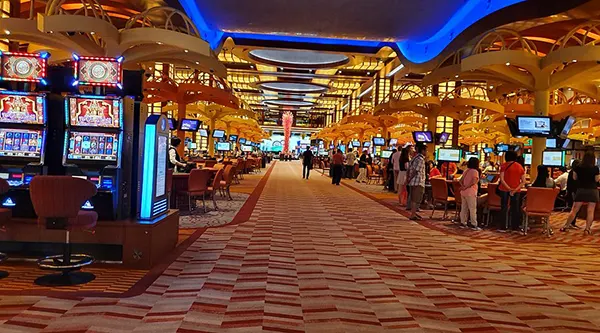
RWS Casino runs 24 hours a day unless otherwise notified, and it is set up as a high-capacity venue rather than a boutique room. The published figures highlight the scale: more than 2,400 slot and electronic table game machines, alongside roughly 450 table games. In practical terms, that means you will usually find an open option even at busy hours, but the atmosphere can vary by time—late evenings often feel more social, while mornings can be quieter and more transactional.
Table games cover the staples most visitors expect—baccarat (commission and non-commission variants), blackjack, roulette, and sic bo—plus a wider mix that can include pai gow, pontoon, and poker variants. If you are new to Singapore casinos, note that some table offerings reflect regional preferences, so you may see more emphasis on baccarat and sic bo than in a typical European casino.
The slot floor tends to be a blend of familiar international titles and Asia-leaning themes, with electronic table games offering a faster-paced alternative when live tables are full. Minimum bets and limits can differ widely by area and time, so it is wise to walk a full loop before committing, especially if you are trying to stick to a budget.
Game rules, fairness controls, and what regulation looks like on the ground
Singapore’s casinos operate under a formal approval system for what games may be offered and how they are played. In plain language, the operator cannot simply introduce a new table game rule set because it is trendy; the rules and modes of play are part of what the national regulator oversees. For visitors, that translates into a more standardised experience and fewer “house rule surprises” than in lightly regulated jurisdictions.
Fairness in a casino is not only about the maths of the game; it is also about process—how disputes are handled, how chips and cash are managed, and how staff respond to irregular behaviour. You will notice security and surveillance are more visible here than in many holiday destinations. That is not cosmetic: Singapore’s regulatory approach prioritises integrity and the reduction of casino-linked crime.
If you want the lowest-friction visit, treat the venue like an airport rather than a bar: keep identification ready, follow signage, and assume rules will be applied as written. That mindset helps avoid awkward confrontations, especially for travellers who are used to more informal casino environments.
Responsible gambling in Singapore: exclusions, visit limits, and in-casino support
Singapore’s model is built around harm minimisation, and the tools are not abstract—they are used. Residents can apply for exclusions that bar entry to casinos, and there are also family-initiated and third-party mechanisms in defined circumstances. Separately, visit limits can restrict the number of casino visits per calendar month for Singaporeans and Permanent Residents, which is a practical way to reduce high-frequency gambling patterns.
Inside RWS Casino, responsible gambling support is not hidden behind fine print. The venue runs trained responsible gambling ambassadors and publishes guidance aimed at correcting common myths about gambling. The tone is generally matter-of-fact: the house edge exists, losses are real, and setting limits is treated as normal adult behaviour rather than a moral failing.
In 2026, technology is increasingly part of the approach. Singapore’s casinos have used tools that let members set time and budget limits and receive reminders or notifications when limits are reached. If you are travelling with someone who is trying to keep strict control, these features—combined with external exclusion/visit-limit schemes—are the most concrete safety net available in a bricks-and-mortar setting.
Planning a visit around Sentosa: transport, timing, and what to combine with it
RWS sits in a resort zone that many visitors reach via HarbourFront/VivoCity and the Sentosa Express monorail. The simplest route for most tourists is to get to HarbourFront, head into VivoCity, then take Sentosa Express to the Resorts World area. Because Sentosa is also an attractions hub, travel time can expand quickly during weekends, school holidays, and evenings when shows finish.
Timing matters more than people expect. The casino itself is 24-hour, but the flow around it is shaped by restaurant reservations, theme park closing times, and transport peaks. If you prefer a calmer first impression, arriving earlier in the day can reduce queue pressure and gives you time to read the floor layout before it becomes busier.
If your group is mixed—some want gaming, others do not—Sentosa makes that workable. You are near major attractions, hotels, and dining, so it is possible to separate for a few hours without anyone feeling stranded. The only real planning requirement is to respect the casino’s entry rules and dress expectations so that the person intending to enter does not derail everyone’s schedule.